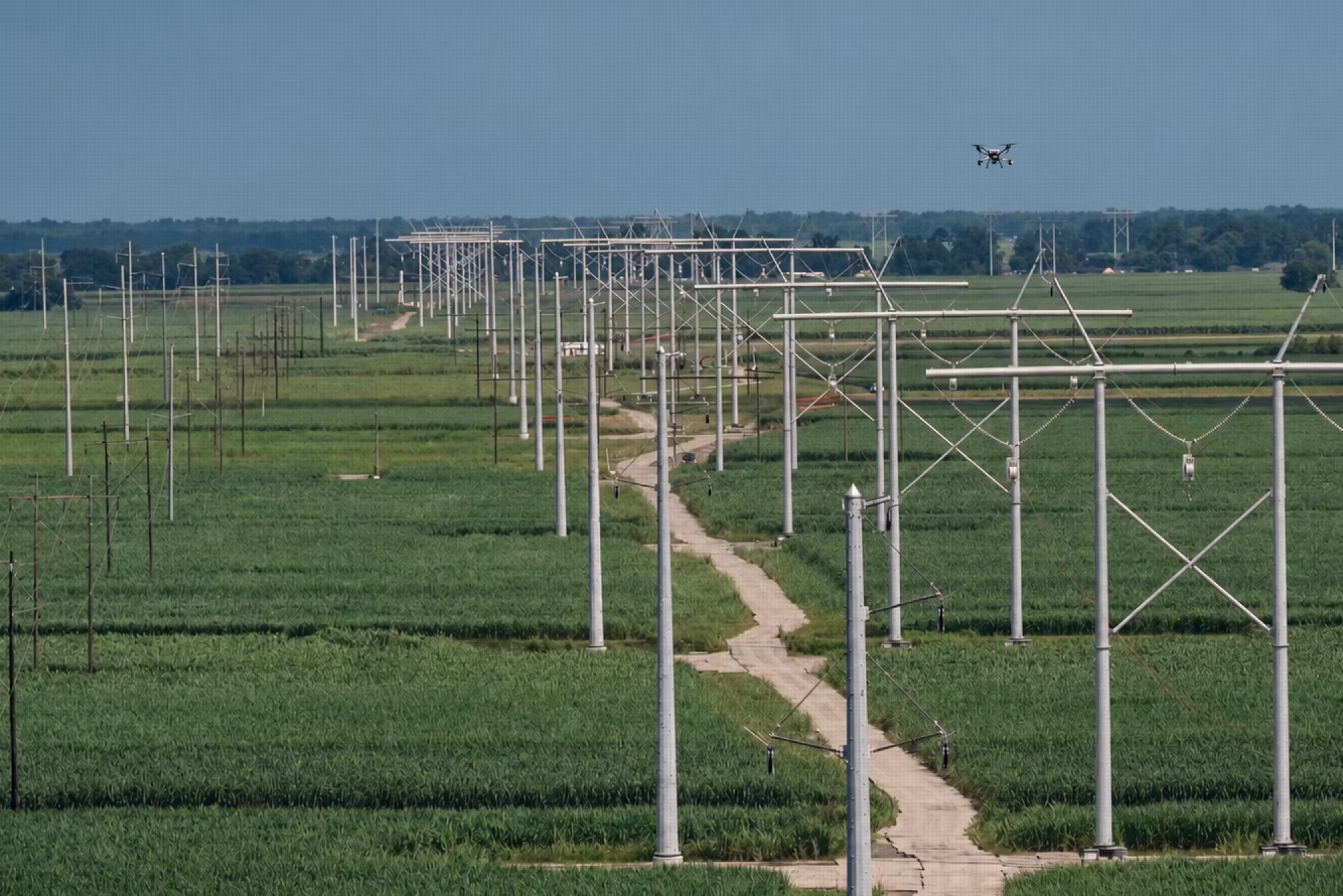
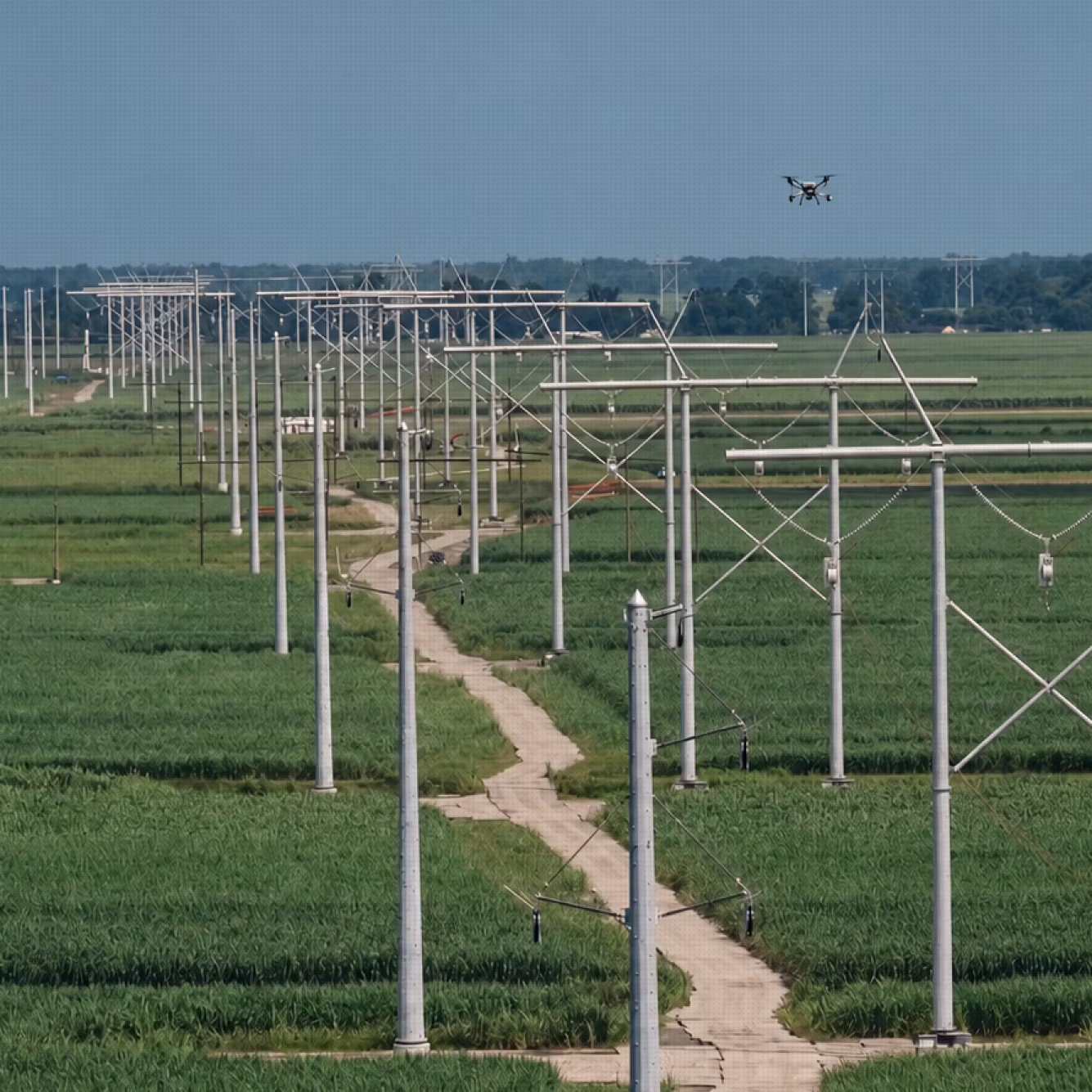
Meeting surging U.S. electricity demand from sources like data centers and heavy industry could require building up to 5,000 miles per year of high-voltage transmission lines, which is ~10X the annual build in 2025.
Entergy alone is currently building hundreds of miles of high-voltage transmission lines, much of which is supporting the utility’s 7-12 GW of new data center loads. Hyperscalers and manufacturers are planting roots in swampy Louisiana, in particular, with 250 miles of a new statewide transmission backbone required to meet surging power demand in that part of Entergy’s service territory.
But with 59% of utilities struggling to hire the right resources to execute this grid construction at all, and much less at the swift pace required, contractors like ULCS are seeking new solutions. Whereas ground crews or helicopters have historically performed this type of power line stringing work, ULCS - in partnership with Entergy - opted for drone-stringing as the faster, safer, and more cost-effective approach to deploy the state’s statewide grid backbone.
Project details: Building a high-voltage transmission backbone with drones
For Infravision, the Amite South Reliability Project is its largest U.S. job to date. And for ULCS, it’s their biggest project yet in Louisiana, as well as the first to utilize drone-stringing.
The work for the Amite South Reliability Project includes stringing 120 miles of parallel 500 kV and 230 kV transmission lines in the marshlands of southern Louisiana. Infravision is responsible for stringing a heavy-duty, ⅝” pilot line through the structure hardware using its drone-based system before handing off to the ULCS team for installation of the single-bundle 230 kV conductor and triple-bundle 500 kV conductor. ULCS and Infravision crews are fully integrated, but work is performed in parallel to maximize labor efficiency, remove unnecessary downtime, and shrink the project’s critical path.
Infravision was selected for its ability to handle both the scale and complexity of the project while also reducing risk, enhancing speed to power, and driving affordability. Stringing through a marsh and in proximity to existing, energized lines presents unique challenges that would have otherwise required specialized equipment for certain sections of the project. But with Infravision, a single solution provides the range of capabilities needed to address all of the project requirements while also improving outcomes.
Speed to power: Driving down stringing time by 25%
Transmission construction is notoriously slow and expensive, which has become abundantly clear during this time of booming power demand. The ability to quickly interconnect new generation and load has never been more important, making the acceleration of grid construction of utmost importance to contractors like ULCS and utilities like Entergy.
Despite power line stringing accounting for only a portion of the overall cost of transmission construction, it’s a huge driver of project execution speed. In particular, pilot line stringing is the first step in the conductor installation process, which means it’s on the critical path of project schedules.
For the Amite South project, ULCS is expecting Infravision to drive the removal of ~4 months from the project’s original 15.5-month stringing schedule, or a ~25% reduction versus using a helicopter for stringing. This significant stringing schedule acceleration will be accomplished in two ways:
1) By speeding up the pilot line stringing process overall through the use of automation. In particular, Entergy stated that Infravision is stringing 4X faster than a ground method would – from 6 days to 1.5 days per pull group. And,
2) By enabling pilot line stringing to be completed in parallel with other work. Utilizing a small, flexible team and Infravision’s TX system allowed the ULCS team of lineworkers to focus on other essential work that only they could perform.
Affordability: Reducing stringing costs by 35%
These time savings and the more efficient use of ULCS labor translate to an expected $11M in savings for the project. Based on early results reported by the ULCS team, Infravision is on track to drive a ~35% reduction in the cost of line stringing.
Infravision is also reducing the likelihood of ballooning costs by handling expected, as well as unexpected, project complexity. ULCS has specifically noted the TX system’s ability to easily navigate challenging environments that would have slowed down other stringing methods, from challenging terrain and inhibited Right-of-Way access points to intersections with existing power lines or other infrastructure.
Safety & disruption: Limiting safety incidents by 25%
Lineworkers experience a fatality rate that is over 4X higher than the national average across all occupations, and that rate goes up when introducing helicopter stringing to the mix of grid construction activities.
From reducing the need for at-height work in structures to replacing helicopters with a safer aerial stringing method, Infravision’s drone-based approach is expected to enable crews to avoid over 25,000 hours of high-risk work. Assuming an industry-standard TRIR of 1.5, this translates to a ~25% reduction in expected recordable incidents - from avoiding minor accidents to saving lives.
Infravision is not only protecting workers, but also the community and the environment. From flying over sensitive or protected terrain to limiting power outages and traffic stoppages by navigating around energized lines and over roadways, drone-stringing is the lowest-impact method available.
Looking ahead: Improving grid deployment
Construction is ongoing, creating an opportunity for even better results as execution teams across Infravision and ULCS strengthen an already strong collaboration and roll lessons learned into future work.
Infravision is proud of the work it has already accomplished with ULCS and Entergy to improve the speed, affordability, and safety of a critical grid backbone deployment in Louisiana as the state supports a rapid influx of large loads. The company also looks forward to continued use of drone-stringing to support high-voltage transmission expansion across the U.S.

