In March 2019, the Australian energy transmission industry was rocked by a tragedy. A pilot was stringing power lines 60 kilometres east of Woomera Airfield in South Australia in what should have been a routine procedure.
But just a few lines into the day’s planned work, and the helicopter main blade struck the power line around 17 metres from ground. It crashed down and killed the pilot on board.
For an industry that had long relied on helicopters for their mammoth stringing tasks, the death sparked calls for change. The company involved in the crash, Aeropower, quickly strengthened its supervision requirements.
But for Queensland energy transmission monopoly Powerlink, this didn’t go far enough. It was already looking at safer and faster ways to string lines, but the accident drove home the importance of doing this quickly.
A relationship with drone stringing company Infravision followed – it was developing the technology the company required, but the start-up needed the backing of a giant like Powerlink to, literally, get it off the ground at scale.
For its technology, Powerlink Queensland has won the category of Innovation at an established company in the inaugural The Australian Financial Review Energy Awards.
Embracing the change required by Australia’s massive energy transition is a key theme among the winners.
As pressure on companies and countries to hit their net zero targets grows, the awards recognise and celebrate the excellence, innovation, service and achievements of the businesses and people driving the future of the energy industry.
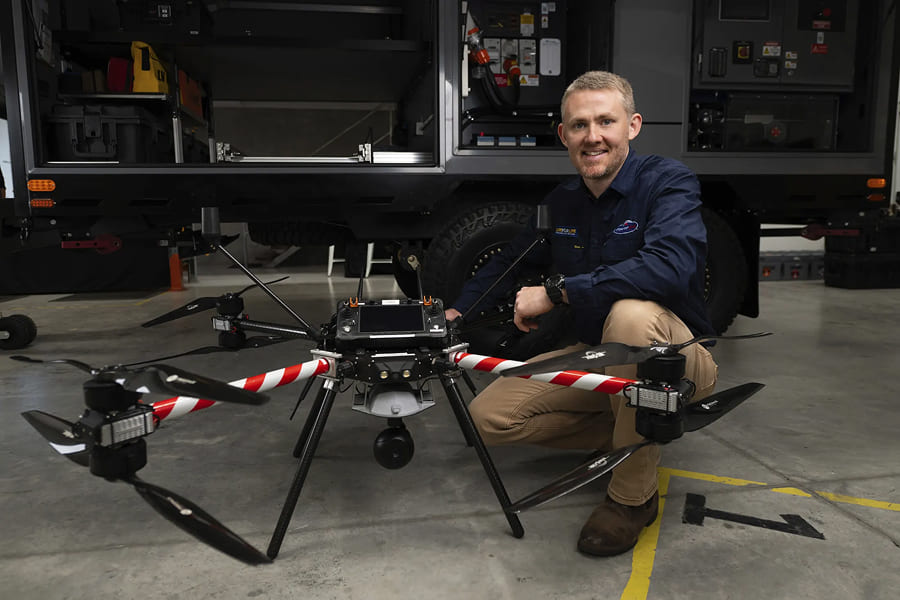
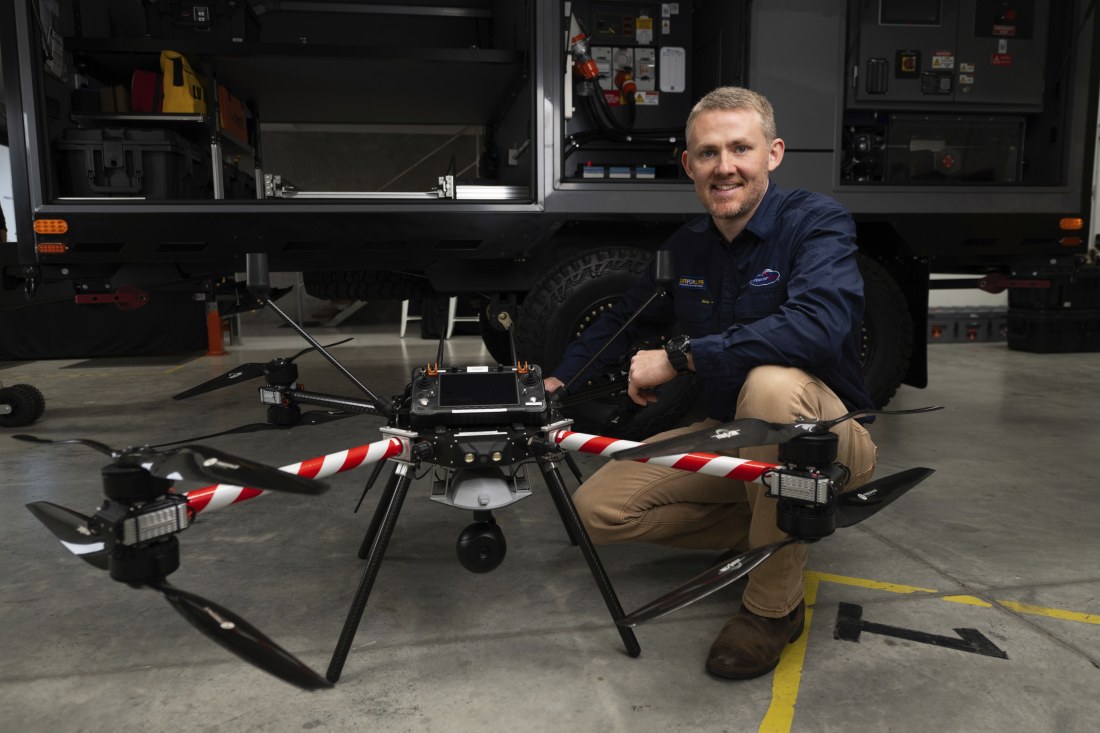
Together, Powerlink and Infravision developed heavy-lift drones with robotic puller systems that allow faster, safer and more sustainable construction of transmission lines. From there, the winner of The Australian Financial Review Energy Award for Innovation at an established company was born.
“There’s always been an inherent risk in using helicopters [to string wires] … but when you’ve done something for so long and it works, you don’t really look outside of that,” Powerlink construction methodologies manager Troy Malcomson says.
“But in an industry that’s been doing the same thing for a long time, to bring anything new in is always challenging.”
He hopes the clear safety, environmental and cost benefits of the drone system will help other companies develop similar projects though and, crucially, embrace change.
“We’re trying to get comfortable with change and really trying to see the benefits and bring people along for the journey,” he says.
“Our culture has evolved at the time, and we’re much more agile than we’ve been in the past. So what we’re trying to do is bring our partners along and get everyone comfortable with new technology solutions, because that’s obviously the way in the future.”
Chosen by a panel of industry experts, business leaders and senior editorial staff from The Australian Financial Review, the Energy Awards winners reflect those leading the way in innovation, customer service, sustainability, health and safety, community engagement and business growth. More than 180 entries were received.
From companies leading the way in developing offshore wind or more sustainable iron to one automating electric vehicle charging to capitalise on when energy is cheap, the breadth of winners and finalists show the transition will require the whole country to get on board.
Industry stalwarts such as Ausgrid, Snowy Hydro and Fortescue were recognised, as were start-ups across manufacturing, occupational safety and even professional services.
Former Origin Energy managing director Grant King also won the inaugural Lifetime Achievement award, reflecting his contribution to the energy sector over decades in private and public sector gigs.
For Malcomson, the changes companies are making to drive the energy transition often come with financial, safety and environmental benefits.
With Powerlink’s drone system, there’s less risk to staff, as the entire process uses an automated power line stringing system supported by the remote-controlled drone rather than requiring anyone to manually reach the required heights.
It also means less damage to vegetation around the powerlines – compared to old methods, Powerlink clears up to 1.2 hectares of vegetation less per kilometre of transmission line constructed.
With arguments against energy transition projects often centring on the amount of land they need, such as for solar or wind farms, cutting these environmental harms is a win.
Social licence
“It’s even good for farmers. We actually had [one project] where cattle were walking around the line construction, where usually they would run away,” Malcomson says.
The project also cuts the time needed to string power lines – it takes three days less to construct each 10km line.
The Queenslander says this all feeds Powerlink’s social licence, too.
“As we’ve been building our network, we’ve been mindful of the impact we’re having on the rest of the state,” he says.
“Not everyone really understands how power gets into their home, so as we’re building things out, we’re trying to do it in the most effective, optimal and efficient way.”
That keeps costs down for consumers, he says, and creates opportunities in communities. Powerlink is training local staff in drone operation and causing less disruption or noise when it installs lines for landowners.
Partnering with Infravision also gave Powerlink the opportunity to back a local start-up that, now it has expanded, is helping other Australian companies improve their practices.
“Infravision is now working in the US and India and Canada – so we’re getting the benefits of knowledge they’re getting and gaining and bringing back, and fast tracking some of our learning,” Malcomson says.
Given the sheer size of the energy challenge ahead for Australia, he reckons “not only being in our own backyard” in terms of innovation and knowledge will help the country.
The system is in use in Powerlink’s Genex Kidston Connection Project, in the largest continuous use of drone stringing technology on a transmission project in the Asia Pacific.
So far, the outlook for its rollout also looks good, as it’s now the company’s preferred method of line installation.
Powerlink is not alone in looking for more sustainable ways of rolling out energy infrastructure. Acciona Energia was also a finalist for Innovation by an established company for a similar scheme to transport wind turbines.
While this once required big trailers and wide roads formed by substantial land clearing, Acciona has developed hydraulically operated adapters mounted on compact 10-axle trailers to move the 29,000-kilogram turbines.
The company says this new approach has already helped save more than 20,000 square metres of land from clearing.
Rio Tinto was a finalist for its BioIron process, which aims to help solve one of the biggest issues stalling the energy transition – how to develop green steel.
With BioIron, Rio uses raw biomass and microwave energy instead of coal to turn Pilbara iron ore into metallic iron in steelmaking.
When using renewable energy and carbon from fast-growing biomass, it has the potential to reduce carbon dioxide emissions by up to 95 per cent compared to the current blast furnace method.
Though it’s not at commercial scale yet, Rio’s general manager for steel decarbonisation, David Leigh, says he hopes it would be by 2035, with a pilot plant commissioned in 2026.
Project planning
It can be used on low to medium-grade ores and, according to Leigh, use two-thirds less clean energy to make steel than the green hydrogen process route, should the latter prove viable.
CoreLogic was recognised for an analytics tool it developed alongside the CSIRO to assess the energy efficiency of properties.
Energy-inefficient homes a significant contributor to non-industrial carbon emissions and heating and cooling costs for consumers. The company hopes to help residents understand the energy footprint of their buildings.
The Monash Energy Institute rounded out the list of finalists for its economic fairways initiative. It uses geospatial modelling and data analytics to help resource developers balance economic and environmental factors in their project planning.
Malcomson hopes companies like these trying and succeeding in improving their businesses will encourage others within the energy transmission industry to do the same.
“Instead of sitting back and letting others do the heavy lifting or following the US, we are trying to be the world’s best. We’re trying to be leaders,” he says.
“Doing things like this [the drone development with Infravision] builds our confidence that we can actually trial new things, and if they’re worth keeping, we implement them in our business.
“And some of those initiatives won’t be great and maybe aren’t fit for purpose, but that’s okay too. We learn and we move on and we grow. It’s just a great time to be in the industry.”