Robotics is playing an essential role in every aspect of Australia’s energy transition, from generation through to transmission and distribution. Energy Source & Distribution looks at how this cutting-edge technology is helping deliver new efficiencies in the race to renewables.
Generation
The Australian Renewable Energy Agency (ARENA) recently announced its allocation of $1.3 million in funding to Built Robotics‘ autonomous piling robots project, which will automate the pile driving processes associated with constructing utility-scale solar farms.
The design and piloting of first and second-generation prototype robots has the potential to reduce piling time and labour costs by approximately 82% and 88% respectively, increasing installation efficiency and safety.
“By helping to automate the most repetitive and difficult tasks on jobsites, Built’s robots aim to lower the cost of energy, accelerate construction and provide safer working conditions for skilled workers,” Built Robotics general manager and vice president of business development Paul Kelly says.
Based in San Francisco with a subsidiary in Australia, Built Robotics has been automating construction machinery since it began operating in 2016. The company has previously launched material handling, earthmoving, and trenching robots, which run through an autonomous upgrade called the Exosystem. Its latest robots, the RPD 35 and RPS 25, are the world’s first and only fully autonomous solution for pile driving and distribution.
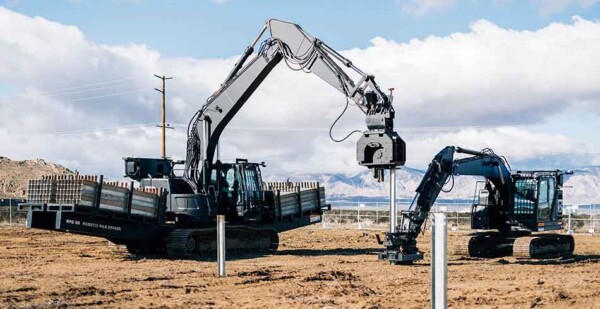
Built Robotics director of communications Erol Ahmed explains, “We’ve taken an excavator and put the Exosystem on it, and we’ve turned it into what we call an RPD, or robotic pile driver. This robot drives the foundations for solar panels into the ground, and pairs with another robot, the RPS, which is a stabilising robot. One robot drives the pile into the ground while the other robot holds it in place.”
These autonomous robots mean construction work can continue around the clock, extending operational windows past traditional eight- or 10-hour shifts. The benefits include efficiency, productivity and safety.
Built Robotics’ communications lead and designer Lauren Lee is quick to point out there’s also a human element to the firm’s technology.
“We have sleds on the side of the RPD that require manual loading. Typically, piles arrive bundled in a configuration that the robots can’t currently support. A manual crew has to take those piles and load them on the sleds so the robot can pick them up. Part of the ARENA funding is improving this process and making it safer and more efficient, ”she explains.
“These crews are either Built Robotics employees or trained operators who really understand the technology and have a good sense of what the robot requires. They’re highly trained and attuned to what the robot’s doing, so they can quickly fix things in the field if needed.
“We’re trying to create a workforce of the future. We like to call them robotic equipment operators—or REOs. Our goal is to see this become a profession. Robots are always going to require people to work beside them and ensure everything is running smoothly.”
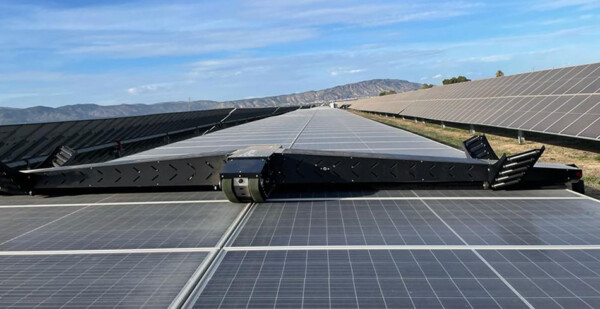
Autonomous robots are also working in established solar projects, with Sicilian company REIWA’s SandStorm robotic system being utilised by global renewables firm Enel Green Power to clean solar photovoltaic panels without the use of water.
When it comes to photovoltaics, dust, dirt and sand can accumulate and decrease, sometimes significantly, the performance of solar power systems. It’s an issue that’s particularly important in areas with low rainfall and/or very dusty soil.
The approach normally adopted involves cleaning the surfaces with pressure washers or tractors equipped with hydraulic brushes; both cases entail water consumption and gas emissions from the equipment used.
To develop a different, more sustainable solution that can also be adopted in large solar parks, REIWA developed SandStorm—an advanced robotic cleaning system capable of moving along the rows of panels autonomously and recharging autonomously, returning to its docking station when its work is done.
Sturdy and versatile, SandStorm even adapts the uneven alignment of the panel trackers, moving autonomously from one row of panels to the next. Robotic cleaning can take place at night, during unproductive hours, so as not to create shading on the panels, which can cause electrical imbalances and damage.
Because the panels can be cleaned every day at a low cost, SandStorm improves plant efficiency as well as sustainability, with no water or fuel required.
Beyond renewables, robots are also being considered for remote caretaking on fossil fuel projects, where conditions are often hazardous.
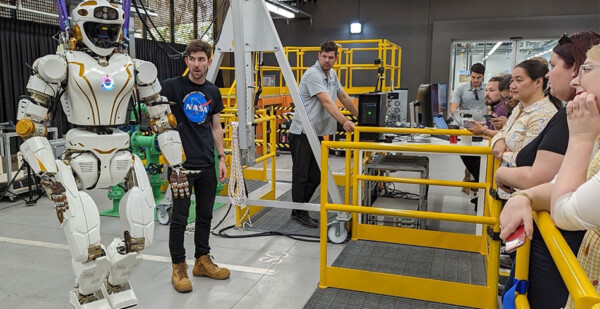
US space agency NASA recently teamed up with Woodside Energy to test the capabilities of its humanoid robot, Valkyrie, for remote caretaking of uncrewed energy facilities.
As part of the collaboration, Valkyrie will advance robotic remote operations capabilities that have potential to improve the efficiency of Woodside’s offshore and remote operations while also increasing safety for both its personnel and the environment.
NASA plans to leverage experience operating Valkyrie in Woodside’s facilities to learn how to better design robots for work in hazardous conditions, like those found on the Moon at the long-term worksites and habitats that will be established as part of future Artemis missions.
“These demonstrations will evaluate the current potential of advanced robots to extend the reach of humans and help humanity explore and work safely anywhere,” NASA dexterous robotics team lead Shaun Azimi said.
Transmission
Electricity transmission is perhaps the most crucial area for advanced robotics, with much of our energy transition dependent on high-voltage transmission lines to carry renewable energy from the source to the substation.
Traditionally, stringing transmission lines involved manual stringing and pulling until helicopters were utilised to perform line stringing, particularly across large valley spans and difficult terrain. While helicopters are still an important part of major transmission projects, many network operators are utilising specialised drone stringing systems to do their high-flying work.
Powerlink Queensland and drone technology specialist Infravision recently won an innovation award for the implementation of drones to string the longest section of high-voltage transmission line in the Asia-Pacific region as part of the connection of Genex’s Kidston Clean Energy Hub to the grid.
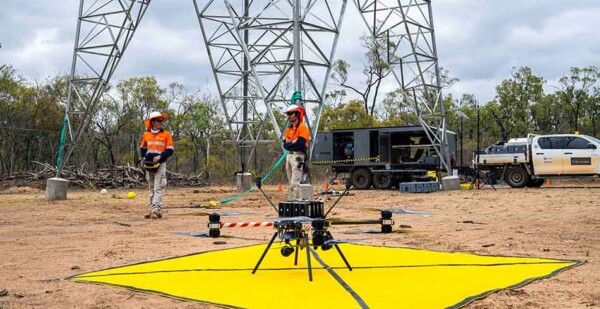
The technology has proved beneficial in reducing impacts to landholders and the environment, eliminating critical safety risks and improving construction times.
Powerlink and Infravision have now embarked on a multi-year supply agreement through which drone stringing will be considered for all transmission projects across Queensland.
The agreement will see Infravision supply multiple packages that combines drones, smart puller tensioners and specialised payloads into one system that strings powerlines, installs hardware and conducts inspections.
Powerlink construction methodologies manager Troy Malcomson says drone stringing has become an important part of the company’s strategy to improve safety and efficiency as it expands its network.
“Obviously helicopters are efficient. They have massive benefits over groundworks, particularly when it comes to hilly or challenging terrain. Drones are now able now to provide that same level of aerial capability but without putting the operator in the air,” he explains.
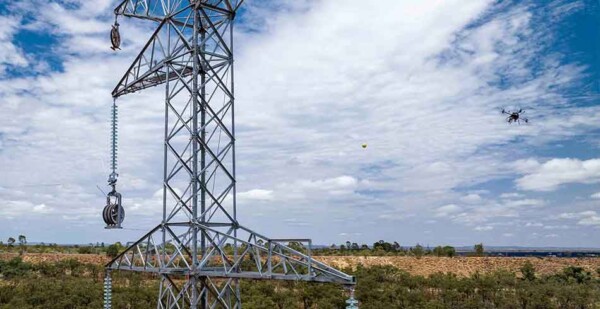
“What we’re able to do with the drones is a trailer-based solution. You can follow in behind the tower assembly and erection crews and, as they get towers up in the air, you can pre-string the lines. So, by the time they’re finished the last tower of that pull, the line is already up in the air waiting for them to start conductor runout.”
Malcomson says when it comes to the use of robotics, the company’s strategy is based on the aggregation of marginal gains.
“It’s based on building 1% better with 1% better efficiency. At scale, those small increments amount to huge gains over time.”
In New South Wales, transmission network operator Transgrid recently trialled NASA-inspired robotic technology in Australian first.
The transmission network has taken delivery of two test units of the Gorilla Mk1 robotic puller, developed in Sydney by Crest Robotics. The wireless technology, designed for use on transmission lines, can be used remotely to deploy safety systems before new conductors are pulled over crossings such as major roads or live powerlines.
Transgrid executive general manager of network Marie Jordan says, “Our network includes more than 13,000km of high-voltage transmission lines in all kinds of challenging terrain and remote locations, so by embracing innovative technology we can better manage risks and reduce costs.”
Crest Robotics’ technology is helping to reduce some of the need for people to work at heights when replacing ageing conductors.
The company’s founder, Dr Clyde Webster, spent five months as a visiting researcher at the NASA Jet Propulsion Laboratory looking at the best way to design lunar rovers for exploring the permanently shadowed regions of the moon.
“Working with the lunar rover program inspired me to look for ways we could bring some of the ideas being used in space and apply them to helping the energy transition here in Australia,” Dr Webster explains.
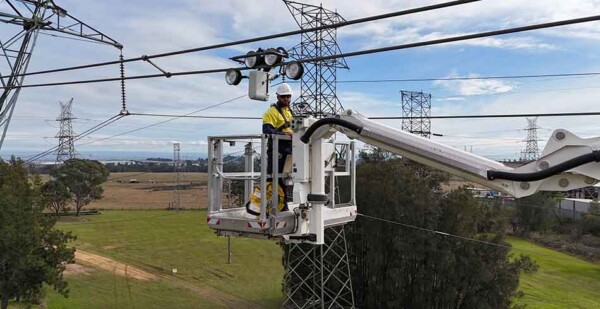
The Gorilla Mk1’s space-inspired design features four motorised hub wheels that can securely clamp onto lines to tow both safety devices and personnel along lines.
The units operate wirelessly and include cameras so the operator can see exactly where they are working on the line and give them a bird’s-eye view for positioning of the device, as well as forward and back looking cameras for situational awareness.
Each Gorilla unit weighs 20kg and can tow up to 280kg on a 30° incline. It can travel up to 20m in a minute, towing a full load and has a range of up to two kilometres, which means it can traverse even the longest spans.
Each of the unit’s wheels contains a motor which clamps securely onto transmission lines and includes smart and dynamic internal control systems, developed in aerospace, to ensure traction and safety of the system is maximised.
The machine is designed to understand the exact amount of force it is applying to the transmission line, which prolongs the life of the tyres and machine components, and protects the line.
Transgrid senior project manager Sean Blakers says the Gorilla Mk1 has the potential to be a gamechanger for transmission crews.
“A huge benefit of using this system is the weight and the manual handling issues it alleviates, as this system is much lighter and can be lifted by one person,” Blakers explains.
Distribution
Several years ago, electricity distributor SA Power Networks trialled a unique approach to asset inspection, employing a robotic dog named Spot to search for damaged powerlines around Adelaide.
Developed by Boston Dynamics, Spot featured autonomous navigation, computer vision and smart robotics to navigate between assets, moving from Stobie pole to Stobie pole while taking images of the poles, powerlines and transformers along the way.
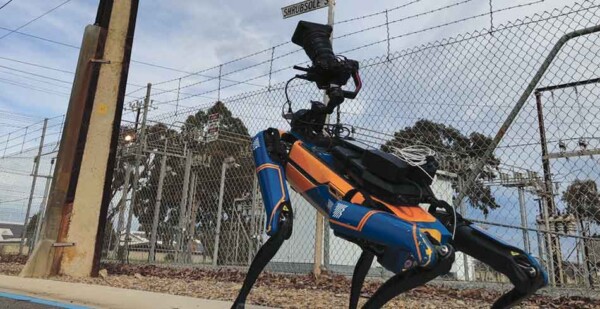
Common issues identified included low lines, damaged poles, and ageing equipment. Paired with a skilled operator, Spot successfully navigated rough terrain that would be too dangerous for a worker.
Training Spot involved AI-driven robotics software developed in-house based on reinforcement learning. Reinforcement learning for Spot was much like training a pet using treats, however, Spot was rewarded with numbers when it performed per the operator’s instructions. If Spot did something ‘good’, such as take a photo of a pole, it received a positive reward. If he did something ‘bad’, such as venture onto a road, it was given a negative reward.
“Spot successfully completed its role as a demonstrator of SA Power Networks’ capabilities in robotics and AI, paving the way for the expanding operation of our drone fleet for use in asset inspections and other operations,” SA Power Networks acting head of corporate affairs Cecilia Schutz explains.
“Nowadays, Spot serves as a brand ambassador for SA Power Networks, attending events and helping us tell the story of innovation and human-robot collaboration that we believe are core to how we empower our people for the future of work.”
The company continues to utilise robotics in its operations. Earlier this year, Australian drone company Carbonix deployed its most advanced, fixed-wing Volanti drone on a beyond visual line of sight (BVLOS) flight to inspect SA Power Networks powerlines in remote locations.
With SA Power Networks’ powerlines spanning more than 180,000km2, long-range drones provide efficient and safe asset inspections.
“Our growing fleet of drones and their use cases represent a natural continuation from our explorations with Spot,” Schutz says.
“In the future, we believe wheeled and walking robots play important roles in helping our workers do more in safer ways, such as helping with handling heavy loads, inspecting where people cannot access, or reducing our need to drive to sites through remote access.”
Related article: How robots could limit the environmental impact of offshore windfarmsHow robots could limit the environmental impact of offshore windfarms
Anthropomorphising robots
In the same way we name our Roombas, companies name their robots, with some suggesting these intelligent machines have unique traits and ‘personalities’.
Built Robotics’ Erol Ahmed says, “Some of our REOs say the robots behave differently and have their own little quirks.”
Asked if there’s benefits to humanising machines by giving them names and encouraging familiarity between robots and operators, he explains, “There is a whole field of study on how people interact with robots. If you’re looking at robots in healthcare or schools, it’s an important consideration. In our field, we treat them as tools but we do humanise them a little bit with names. People naturally anthropomorphise them.”
Powerlink’s Troy Malcomson agrees.
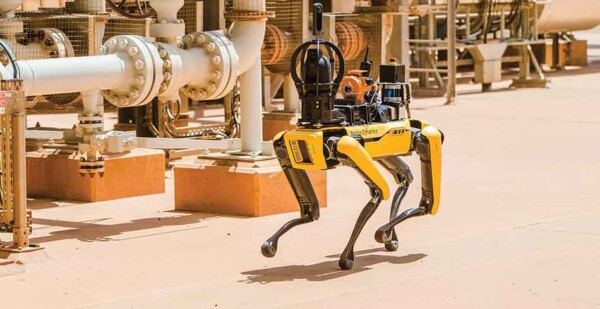
“The drones we use are basically just bigger versions of what you would typically see. They’re not too scary. Companies like Crest Robotics mimic nature with their robot designs, like the Gorilla, and some of their climbing robots are based on the claw aspect of a parrot.”
Because our brains are pattern recognition machines, humans respond better to things that look like us or things we have an affinity.
The Goethe-Institut London recently published an article about the psychology of our feelings towards robots, which says robots that look like friendly animals are generally welcomed and enjoyed, while robots that assume a human or near-human form can often be unnerving.
Essentially, we want robots to be friendly and familiar—like us, but not too much like us.